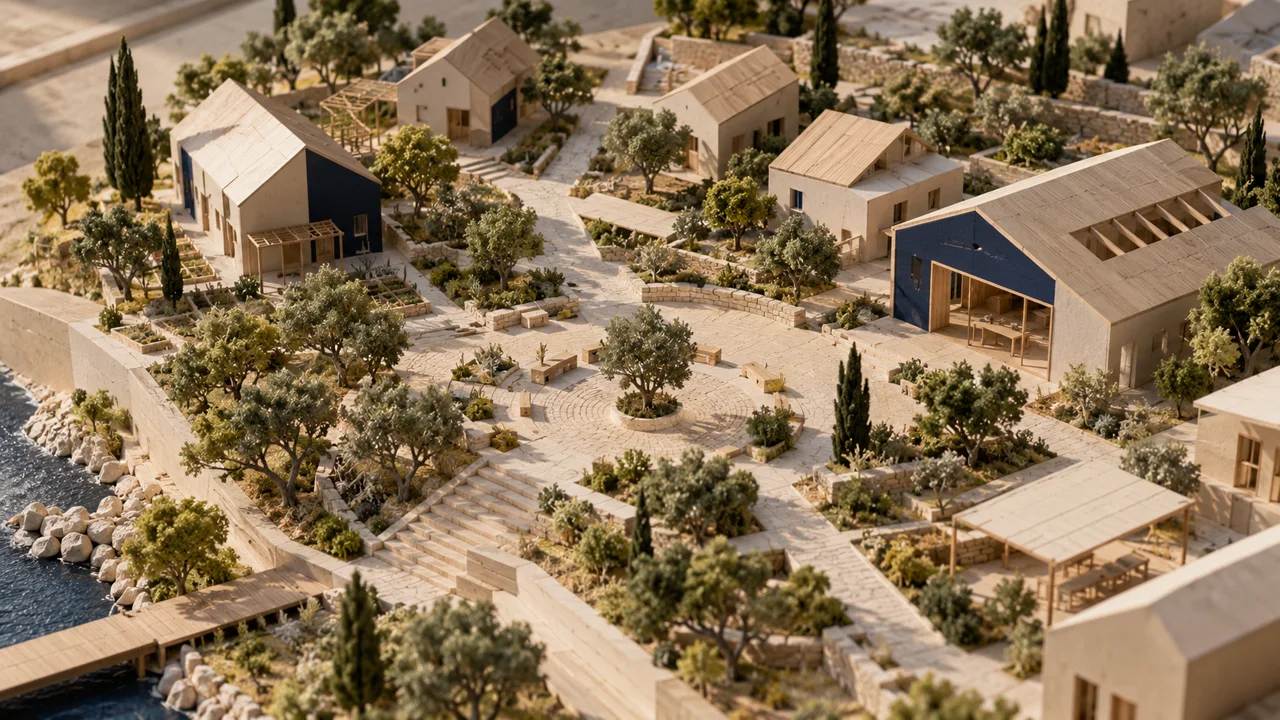
MAP IDEAS
Architecture of the Smyslov Park
Map idea
The map shows how the ideas of humanity have developed.
It combines:
- Science
- Philosophy
- Culture
- Technology.
Each idea is a knot of meanings connected with other ideas.
This makes the park an architecture of thought.
Spatial form
The map has a circular structure.
Diameter: 120–150 meters
Center: Temple of Knowledge
There are ray of ideas from the center.
Map structure
The map consists of 7 levels of meanings.
1 Level - Foundations of the Universe
- Mathematics
- Physics
- Space
- energy.
2 level — Life
- Biology
- Ecology
- medicine.
3 level — Earth
- Geography
- climate
- Oceans.
4 level — Technology
- Engineering
- digital systems
- Energy.
5 level — Society
- economy
- Law
- management.
6 level — Culture
- Art
- philosophy
- religion.
7 level — Future
- Space Civilizations
- New forms of life
- development of mind.
4. 741 Node of Ideas
The map can include 741 semantic module - as we are already developing in the Union system.
Each node is:
- idea
- Opening
- Technology
- The cultural principle.
Map Architecture
Elements:
- Stone Circles
- Light Lines
- Interactive Panels
- Sculpture of ideas.
Lines connect ideas, showing their interconnection.
Interactivity
The visitor can:
- Studying ideas
- Listen to explanations
- See the connections between discoveries.
The map becomes a living textbook of civilization.
Night atmosphere
At night, the map turns into a galaxy of meanings. Every knot glows. The lines between them form constellations of ideas.
Connection with park architecture
Map of ideas connects:
Towers of Knowledge
↓
Galactic Alley
↓
Map of Ideas
↓
Temple of Knowledge
↓
Tree of Peace
This turns the park into an architecture of knowledge and meaning.
Why is it a very strong idea
This map makes the park:
- Encyclopedia in the open air
- the Educational Center
- Space of Philosophy.
The visitor can literally go through the development of civilization.
Geometry of Knowledge is the next level of Architecture of Meaning If the Map of Ideas shows the development of knowledge, then the Geometry of Knowledge shows the structure of the very thinking of mankind.
This could be the central intellectual model of the Park of Reference.
GEOMETRY OF KNOWLEDGE
Spatial Model of Civilization
Basic idea
Knowledge develops not chaotically, but according to a certain structure.
This structure reminds:
- Crystal
- Galaxy
- neural network.
The geometry of knowledge shows how ideas connect and create civilization.
Central Core
In the center is the single truth. It is manifested through three bases:
- Nature
- Mind
- Creativity
These three forces create a triangle of knowledge.
The Seven Rays of Knowledge
From the center there are 7 directions of civilization:
- Mathematics
- Physics
- Life
- Land
- Technology
- Society
- Culture.
Each ray leads to its discoveries.
12 fields of science
Each beam is divided into 12 scientific fields.
This corresponds to 12 Knowledge Towers.
For example:
- energy
- Space
- Medicine
- Ecology
- Art.
100 Stars of Ideas
Inside the spheres are 100 key ideas of civilization.
They are already represented on the Galactic Alley of Scientists.
741 knowledge module
The entire system can contain 741 semantic node.
Each node is:
- scientific discovery
- Technology
- cultural idea
- philosophical principle.
This corresponds to the KRISTALL741 EQUILIBRIUM system that you are developing.
Architecture in the Park
Knowledge geometry can be implemented as a square or garden.
Elements:
- Stone Circles
- Light Lines
- Crystal Columns
- Interactive panels.
The visitor can walk within the structure of knowledge.
Night Visualization
At night, all the geometry glows:
- Lines - light rays
- nodes — luminous points
- The center is a shining crystal.
This turns the map into a galaxy of knowledge.
Complete structure of the park
Now the whole system looks like this:
12 Tower of Knowledge
↓
Galactic Alley
↓
Map of Ideas
↓
Geometry of Knowledge
↓
Temple of Knowledge
↓
Tree of Peace
This is a whole architecture of civilization.
The Crystal of Knowledge is the pinnacle of the entire architecture of the Park of Reference. If the Temple of Knowledge is the heart, then the Crystal of Knowledge is its symbol and energy center. It combines the geometry of knowledge, the map of ideas and the towers of science.
CRYSTAL KNOWLEDGE
Central Symbol of Architecture of Smysl
Basic idea
The crystal is a symbol:
- Clarity
- Structures
- Harmony of knowledge.
Just as a crystal has a strict geometry, so does knowledge have its own internal structure.
The crystal becomes the organized mind of civilization.
Architecture
Height: 25–40 meters
Form:
- Polyhedron
- crystalline structure
- transparent borders.
Materials:
- Glass
- Metal
- Crystal Panels
- LED lighting.
Geometry
A crystal can reflect the structure of knowledge:
7 faces — 7 rays of knowledge
- Mathematics
- Physics
- Life
- Land
- Technology
- Society
- culture.
12 vertices
Each peak represents one Tower of Knowledge. That is:
- Mathematics
- Physics
- Space
- Biology
- energy
- Medicine
- Technology
- Ecology
- Art
- History
- Land
- the future.
100 facets of ideas
On the surface of the crystal can be engraved 100 great ideas of mankind. Link with the Galactic Alley of Scientists.
741 Light Node
741 points of light can be placed inside the crystal. Each point is one knowledge module. This creates a light model of KRISTALL741 EQUILIBRIUM.
Inner space
Inside the crystal, you can make a hall of knowledge. There are:
- Hologram Science
- Models of the Universe
- Interactive panels.
The visitor is inside the geometry of knowledge.
Night atmosphere
At night, the crystal becomes a light beacon of knowledge.
Light passes through the edges and creates:
- Rays
- geometric patterns
- color spectra.
It's like a light passing through a prism.
Place in park architecture
The Crystal is located next to the Temple of Knowledge and the Tree of Peace.
Scheme:
Towers of Knowledge
↓
Galactic Alley
↓
Geometry of Knowledge
↓
Crystal of Knowledge
↓
Temple of Knowledge
↓
Tree of Peace
Value
Crystal Knowledge becomes:
- the Main Symbol of the Standard Park
- Symbol of Architecture
- symbol of the civilization of knowledge.
It can become as recognizable as:
- Eiffel Tower
- Statue of Liberty.
If you develop this concept even further, you can create a "Crystal City of Knowledge" around the Park of Reference - a whole scientific and cultural area of the future. It will be a new city.
Then we go to the next level of the project - the Crystal City of Knowledge. This is not only a park, but a new type of city built around science, culture and harmony of nature.
CITY OF KNOWING
Crystal Cities of the Future
City idea
The crystal city is built on the principles of:
- Geometry
- Ecology
- Knowledge
- harmony of space.
The city resembles a crystal where each part is connected to the others.
This is the opposite of chaotic urban development.
Central Core
In the center of the city is the Park of Reference. Inside it:
- Temple of Knowledge
- Crystal of Knowledge
- Tree of Peace
- Planet Square
- Geometry of Knowledge.
It is the intellectual heart of the city.
Crystal Structure
The city is divided into geometric sectors.For example:
- Hexagonal areas
- Radial Streets
- Ring parks.
This structure reminds:
- Honeycomb
- Crystals
- Neural networks.
City areas
Scientific Area
- Universities
- Laboratory
- research centers.
Cultural area
- Theatres
- Museums
- Galleries.
Residential area
- Ecological Homes
- Green Yards
- public spaces.
Technological area
- Innovative companies
- Startups
- Engineering laboratories.
Natural area
- Forest Parks
- Botanical Gardens
- water systems.
Architecture of buildings
Buildings may have the following forms:
- Crystals
- Polytopes
- Spheres
- domes.
Materials:
- Glass
- Tree
- Metal
- Biomaterials.
Environmental system
The crystalline city works as a living ecosystem.
Systems:
- Solar Energy
- Rainwater collection
- Green roofs
- Natural ventilation.
Transport
The city is focused on:
- pedestrian zones
- Bicycles
- electric transport.
The city center is without cars.
Image of city
The city should look like an architectural crystal. During the day is transparent geometry. At night, a soft glow.
Global Network
Crystal cities can appear in different countries. Each city is connected to: the network of World Parks.
Long-term vision
In 30–50 years, a global network of Crystalline Cities of Knowledge could emerge. These will be:
- Scientific Centers
- Capitals of Culture
- Ecological cities.
We will create a Map of 12 Crystal Cities of Knowledge, a planetary network of cities that connect science, culture, technology and nature. Each city becomes a crystal of civilization, and together they form the global geometry of knowledge.
MAP 12 CRYSTAL CITIES
Planetary Network of Knowledge
Central Crystal
Eurasia - Heart of the World
The main city of knowledge.
Functions:
- Park of Reference
- Temple of Knowledge
- Crystal of Knowledge
- International Academy.
This city becomes the intellectual center of the network.
Europe - City of Culture
Focus:
- philosophy
- Art
- Humanities.
Possible locations:
- Vienna
- Paris
- Florence.
East Asia — City of Technology
Focus:
- Robotics
- digital systems
- artificial intelligence.
Possible locations:
- Tokyo
- Seoul
- Shanghai.
South Asia - City of Spiritual Philosophy
Focus:
- Consciousness
- Medicine
- spiritual practices.
Possible locations:
- Varanasi
- Delhi.
Middle East: City of Energy
Focus:
- energy
- Desert Technology
- sustainable cities.
Possible locations:
- Dubai
- Doha.
Africa - City of Life
Focus:
- Biology
- Ecology
- natural systems.
Possible locations:
- Nairobi
- Cape Town.
North America: City of Innovation
Focus:
- Startups
- Technology
- Universities.
Possible locations:
- Boston
- San Francisco.
Latin America - City of Civilizations
Focus:
- Ancient cultures
- Nature
- Archaeology.
Possible locations:
- Mexico City
- Cusco.
Oceania - City of Oceans
Focus:
- Oceanology
- climate
- Marine technology.
Possible locations:
- Sydney
- Auckland.
North - City of Nature
Focus:
- Arctic Studies
- climate
- Ecosystems.
Possible locations:
- Iceland
- North of Russia.
Mediterranean: City of Ancient Wisdom
Focus:
- philosophy
- History of Civilization.
Possible locations:
- Athens
- Rome.
Antarctica: City of the Future of Science
Focus:
- Space
- climate
- Planetary research.
It will be the international scientific station of the future.
Network geometry
12 cities form the crystalline structure of the planet.
12 Crystals of the Planet
↓
Network of Knowledge Cities
↓
Park of Reference
↓
Crystal of Knowledge
Result
This map creates:
- New Geography of Civilization
- a Network of Scientific Centers
- Global system of cooperation.
Each city is a node of knowledge, and the entire network is a crystal of human civilization.
Then we will create an ATLAS OF CRYSTAL CITIES OF KNOWLEDGE — a strategic document and a map of future civilization. It will be a global map of cities of science, culture and meaning, linked by a single philosophy.
ATLAS OF CRYSTAL CITIES
Global Geography of Knowledge
Idea of Atlas
Atlas shows a new map of civilization.
Instead of traditional geography:
- States
- Borders
- Conflicts
A map appears:
- Knowledge
- Culture
- cooperation.
Atlas Structure
The Atlas consists of three levels of cities.
Level I - Crystal Capitals
12 the main cities of knowledge of the planet. They form a planetary network of centers of civilization.
Level II: Regional Cities of Knowledge
About 60–80 cities. Functions:
- Universities
- Research Centers
- technology parks.
III level — Cities of culture and nature
Up to 300 cities.
Focus:
- Ecology
- Education
- culture.
Atlas Geometry
Cities form a crystalline network. The structure reminds:
- Neural Network
- Galaxy
- crystal.
Central node: Park of Reference and Crystal of Knowledge.
Main directions
Each city can specialize in a specific area.
- Space
- Biology
- Oceans
- energy
- Culture
- artificial intelligence.
Visual structure of Atlas
The Atlas may include:
- Planet map
- City Schemes
- architectural concepts
- Routes of cooperation.
International Network
Cities are connected through:
- scientific programs
- University Exchanges
- Cultural Festivals
- technological projects.
A vision of the future
Atlas shows what a knowledge civilization might look like in 50–100 years. This is a network of cities:
- Eco-friendly
- Intelligent
- Culturally.
Role of Russia
Russia is the Heart of the World.
There may be:
- Park of Reference
- Crystal of Knowledge
- International Academy of Civilization.
Practical application
Atlas can be:
- International Initiative
- Educational Project
- Architectural program of the future.
Atlas Symbol
The symbol of the network can become the Crystal of the Planet - a geometric model of knowledge and civilization.
MANIFESTO
Civilizations of Knowledge
1. Humanity is entering the age of knowledge.
The main resource of civilization is not power and not raw materials, but reason, knowledge and culture.
2. The planet is the common home of mankind
Earth is a single system of life. Its preservation is the highest task of civilization.
3. Science is the basis of development
Scientific knowledge is an instrument for understanding the world and the development of society.
4. Culture is the soul of civilization
Culture connects generations, peoples and civilizations, creating a space of dialogue and mutual understanding.
5. Education is the way of human evolution
Everyone has the right to develop knowledge, talents and abilities.
6. Technology should serve the people.
Technological progress should strengthen:
- Health
- Nature
- Society
- harmony of the planet.
7. Cities of the Future: Cities of Knowledge
The future belongs to the cities where:
- Science
- Culture
- Nature
- Technology.
8. Cooperation instead of conflict
The world is developing through knowledge sharing and cultural cooperation.
9. Park of standards — a symbol of the civilization of knowledge
Knowledge parks become a space where a person meets:
- with nature
- Science
- Culture.
10. The future is being created today
Each generation builds the future of humanity through:
- knowledge
- creativity
- Responsibility.
Manifest Formula Symbol
Man + Knowledge + Nature = Civilization of the Future
CONSTITUTION
Civilizations of Knowledge
Article 1
Man as the highest value
Man, his life, development and dignity are the highest value of civilization. The main task of society is to unleash the potential of each person.
Article 2
Knowledge as the basis of civilization
Knowledge is the main resource of human development. The free flow of knowledge is the foundation of progress.
Article 3
Unity of the Planet
Article 4
Education for all
Everyone has the right to:
- Education
- ability development
- Access to knowledge.
Education is a lifelong process.
Article 5
Science and creativity
Scientific research and creative activity are the driving forces of the development of civilization. Society supports the free pursuit of truth.
Article 6
Technology for Good
Technology should serve:
- Man
- Nature
- sustainable development of the planet.
Article 7
Cities of Knowledge
The cities of the future are built as:
- Science Centers
- the Cultural Space
- Harmonious ecosystems.
Crystal cities are becoming a new model of urbanism.
Article 8
Cooperation of peoples
The peoples of the Earth are united through:
- knowledge
- Culture
- science.
Peace and cooperation are the highest form of civilization.
Article 9
Knowledge Parks
The World Parks and the Park of Reference are created as spaces:
- Science
- Nature
- Culture
- Education.
Article 10
Freedom of thought
Freedom of scientific and philosophical thought is the foundation of the civilization of knowledge.
Article 11
Responsibility of Generations
Each generation is responsible for preserving and developing the knowledge of humanity.
Article 12
The Future of Civilization
The purpose of the civilization of knowledge is harmonious development:
- Human
- Nature
- Technology
- culture.
Constitution Formula
Knowledge + Culture + Nature = Harmonious Civilization
Conceptual system:
- Parks of the World
- Park of Reference
- Temple of Knowledge
- Crystal of Knowledge
- Crystal Cities
- Atlas of Knowledge Cities
- The Constitution of the Civilization of Knowledge.
We will create a Constituent Declaration of the International Assembly of Peace Parks, a document that forms a global organization uniting:
- Parks of the World
- Cities of Knowledge
- Crystal Cities
- Scientific and cultural centers.
INSTITUTORY DECLARATION
the International Assembly of Peace Parks
Preamble
We, representatives of the scientific, cultural, social and educational communities of different countries, aware of the need to develop a civilization of knowledge,
Seeking to strengthen peace and cooperation among peoples, we establish the International Assembly of Peace Parks as a global platform for the development of science, culture and harmonious interaction between man and nature.
Article 1
Establishment of the Assembly
The International Assembly of Peace Parks is an international organization that unites cities, universities, foundations and public initiatives.
Article 2
Mission
The Assembly's mission:
- Development of knowledge culture
- Creation of Peace Parks
- Building Cities of Knowledge
- Strengthening the cooperation of peoples.
Article 3
Main objectives
The objectives of the Assembly are as follows:
- the Peace Parks Network
- Creation of educational spaces
- support of scientific initiatives
- development of cultural dialogue.
Article 4
International Network
The Assembly shall establish a global network of:
- Peace Parks
- Crystal Cities of Knowledge
- scientific and cultural centers.
Article 5
Park of Reference
Standard Park is the symbolic center of the international network of Peace Parks. It serves as a demonstration space:
- Achievements of Science
- Cultural Heritage
- Architecture of Knowledge.
Article 6
Members of the Assembly
Participants may be:
- City
- Universities
- Scientific Centers
- cultural organizations
- Public funds.
Article 7
Assembly programmes
The Assembly implements international programmes:
- Creation of Peace Parks
- Development of Knowledge Cities
- educational projects
- cultural festivals.
Article 8
International forums
The Assembly shall hold regular:
- Scientific Congresses
- Knowledge Cities Forums
- festivals of culture and science.
Article 9
Symbol of the Assembly
The symbol of the Assembly is the Crystal of Knowledge, reflecting the harmony of science, culture and nature.
Article 10
The Future of Civilization
The Assembly shall act in the name of the formation of a civilization based on:
- Knowledge
- Cooperation
- Respect for nature.
Assembly motto
Knowledge is the basis of peace.
Culture is the basis of civilization.
Nature is the basis of life.
Then we will draw up the Charter of Peace Parks, an international document that cities, universities, foundations and states can sign by joining the network of Peace Parks and Cities of Knowledge.
CHARTER OF PEACE PARKS
International Agreement on the Space of Knowledge, Culture and Nature
Preamble
We, representatives of cities, scientific institutions, cultural organizations and public initiatives,
Aware of the responsibility towards humanity and the planet,
Desiring to strengthen the cooperation of peoples through knowledge, culture and respect for nature,
We accept the present Charter of the Parks of Peace as the basis of the international network of spaces of knowledge and harmony.
Article 1
Parks of the World
Parks of the World are created as public spaces that unite:
- Science
- Culture
- Nature
- Education.
Their mission is to create a culture of knowledge and cooperation.
Article 2
Objectives of the Peace Parks
Peace parks serve the following purposes:
- Science Development
- Cultural Dialogue
- Environmental Education
- harmonious development of man.
Article 3
Park of Reference
The Park of Reference is the symbolic center of the Peace Parks network and the demonstration space:
- Laws of Nature
- Achievements of Science
- cultural traditions of mankind.
Article 4
Network of Knowledge Cities
Cities supporting the Charter form an international network of Knowledge Cities based on the principles of:
- Openness
- Scientific Cooperation
- cultural exchange.
Article 5
Knowledge Architecture
Parks of the World develop architectural spaces dedicated to:
- Science
- Culture
- History of Civilization.
These spaces include:
- Temples of Knowledge
- Alley of Scientists
- Gardens of Civilization
- Towers of Science.
Article 6
Education
Parks of the World are open educational spaces for:
- Children
- Students
- Researchers
- citizens.
Article 7
Culture of peace
Peace parks contribute to the strengthening of a culture of peace and understanding among peoples.
Article 8
Environmental responsibility
Each Peace Park is built with respect for nature and sustainable development principles.
Article 9
International cooperation
Charter participants develop cooperation through:
- scientific programs
- educational projects
- Cultural Festivals
- Exchange of knowledge.
Article 10
Network Symbol
The symbol of the World Parks network is the Knowledge Crystal, which reflects the structure and harmony of human knowledge.
Conclusion
The Peace Parks Charter is open for accession:
- Cities
- Universities
- Scientific Centers
- Cultural Organizations
- international institutions.
The motto of the Charter
Knowledge brings humanity together.
Nature unites the planet.
Culture unites civilization.
STRUCTURE
the International Assembly of Peace Parks
the Council of the Civilization of Knowledge
The supreme strategic body. Functions:
- Defining a long-term strategy
- the Network of Knowledge Cities
- International cooperation.
The composition may include:
- scientists
- Philosophers
- Architects
- cultural leaders.
Peace Park Academy
Scientific and Educational Center of the Assembly.
Tasks:
- development of park concepts
- educational programs
- Research.
The Academy brings together:
- Universities
- Research Centers
- scientific laboratories.
World Forum of Cities of Knowledge
The annual international forum.
Topics:
- Cities of the Future
- Architecture of Knowledge
- sustainable development
- culture and education.
The forum can become a global summit event.
the Peace Parks Development Fund
Financial structure.
Functions:
- Financing of projects
- Support for new parks
- Grants for research.
The Fund can work with:
- States
- Universities
- private funds.
International Network of Peace Parks
basic infrastructure. It includes:
- Park of Reference
- Regional Parks
- City Knowledge Parks.
Institute of Architecture of Smyslov
Concept Development Center:
- Geometry of Knowledge
- Crystal Cities
- educational spaces.
It is the intellectual laboratory of the whole system.
The Cities of Knowledge Program
Development programme:
- Crystal Cities
- University Cities
- scientific clusters.
International Youth Academy
Program for:
- Students
- Young Scientists
- Researchers.
Task: formation of a new generation of leaders of the civilization of knowledge.
Cultural program
The Assembly shall organize:
- Science Festivals
- Art Residences
- cultural exchanges.
Secretariat of the Assembly
The administrative center.
Functions:
- Programme coordination
- International Relations
- Project management.
General system architecture
the Council of the Civilization of Knowledge
↓
International Assembly
↓
Peace Park Academy
↓
Forum of Cities of Knowledge
↓
the Development Fund
↓
The Peace Parks Network
Result
This structure turns the project into:
- International Movement
- a Network of Scientific and Cultural Centers
- The development of cities of the future.
Now we have actually formed a whole civilization model:
- Parks of the World
- Park of Reference
- Architecture of Smyslov
- Crystal of Knowledge
- Crystal Cities
- Atlas of Cities of Knowledge
- International Assembly.
FEDERAL PROGRAMME
"City of Knowledge"
Mission of the program
Creating a new type of urban space in Russia - the City of Knowledge, where they unite:
- Science
- Education
- Culture
- Technology
- Nature.
The city becomes the center of the civilization of knowledge.
Central Object
Park of Reference
Heart of the City of Knowledge
Includes:
- Temple of Knowledge
- Crystal of Knowledge
- Tree of Peace
- Geometry of Knowledge
- the Alley of Great Scientists
- Gardens of Civilization.
It is the symbolic center of the whole system.
Crystal Structure of the City
The city is built on the principle of geometric harmony.
Elements:
- Radial Structure of Streets
- Ring Parks
- Hexagonal quarters.
This creates a crystalline architecture of the city.
Scientific cluster
A powerful scientific center is being formed in the city.
Includes:
- Universities
- Laboratory
- Research Institutes
- technology parks.
Cultural Center
The city includes:
- Theatres
- Museums
- Concert Halls
- Art galleries.
Culture is becoming an important part of urban life.
Environmental system
The city operates as an ecological ecosystem. Systems:
- Green Parks
- Solar Energy
- Water Channels
- Ecological transport.
Educational system
It is created in the city
- International Academy of Peace Parks
- Universities
- the School of the Future
- Scientific laboratories for children.
Economic model
The city becomes the center:
- Innovative Technologies
- Scientific Startups
- educational programs
- International Projects
International role
The City of Knowledge can be:
- the International Scientific Center
- the World Forums
- symbol of the civilization of knowledge.
Stages of implementation
Stage 1 Establishment of the Park of Reference
Stage 2 Development of scientific and educational cluster
Stage 3 Construction of the Crystal City
Stage 4 Inclusion of a city in the global network of knowledge cities.
Result of the program
Russia will become the center of the global network of knowledge cities, where:
- Science
- Culture
- Technology
- Nature.
NATIONAL PROJECT
"PARKS OF PEACE AND THE CITY OF KNOWLEDGE"
Strategic objective
Creation in the Russian Federation of a system of World Parks and Cities of Knowledge as a new infrastructure for the development of science, culture, education and ecologically harmonious cities. The project aims to form a civilization of knowledge based on:
- Scientific Progress
- Cultural Development
- Harmony between man and nature
- International cooperation.
Main objectives of the project
- Creating a Park of Reference as a Central Symbol of Knowledge
- Development of the Peace Parks network in the regions of Russia
- the Crystal City of Knowledge
- Building an International Network of Knowledge Cities
- development of educational and scientific programs.
The central project object
Park of Reference
Park of standards is a key element of the program.
Its structure includes:
- Temple of Knowledge
- Crystal of Knowledge
- Tree of Peace
- Alley of Great Scientists
- Geometry of Knowledge
- Gardens of Civilization
- Towers of Science.
The park becomes a space where:
- Science
- Culture
- Nature
- Education.
The Peace Parks Network
The project provides for the creation of a network of parks in the regions of Russia.
Parks perform the functions of:
- Educational Centers
- Scientific and Cultural Spaces
- Public parks of a new type.
Cities of Knowledge
Within the framework of the project, a new type of urban development is being formed - the City of Knowledge. These cities are united:
- Universities
- Scientific Centers
- Innovative Enterprises
- Cultural Spaces
- Natural parks.
International role of the project
The project can become the basis for international cooperation and the creation of a global network of knowledge cities.
Russia can take the initiative:
- the International Assembly of Peace Parks
- the World Forum of Cities of Knowledge
- Global educational programs.
Economic impact
The project creates:
- New scientific and technological clusters
- International Educational Centers
- Innovative Enterprises
- tourist and cultural spaces.
Social impact
The project development will allow:
- improve education level
- Create new jobs
- Improving the urban environment
- develop culture and science.
Stages of implementation
Stage I Concept development and development of the Park of Reference
Phase II Formation of the Peace Parks Network in the Regions
Stage III Creation of the Crystal City of Knowledge
Phase IV Integration of the project into the international network of knowledge cities
Project coordination
The project can be implemented with the participation of:
- Federal Authorities
- Scientific Organizations
- Universities
- public and international funds.
Project motto
Knowledge is the power of development.
Culture is the basis of civilization.
Nature is the source of life.
APPEAL
the National Project
Parks of Peace and Cities of Knowledge
Dear colleagues!
In the context of the rapid development of science, technology and global challenges of our time, the formation of a new infrastructure for the development of society based on knowledge, culture and harmonious interaction between man and nature is of particular importance. In this regard, it is proposed to initiate a national project "Parks of Peace and Cities of Knowledge", aimed at creating a network of scientific and cultural spaces of a new type in the Russian Federation.
The central element of the project is the creation of the Park of Reference - a unique public space that combines the achievements of science, culture and environmental architecture. The park will become a symbolic center of the Peace Parks network and a platform for international scientific and cultural cooperation.
The project provides for:
• creation of a network of Peace Parks in the regions of the Russian Federation;
• formation of the pilot City of Knowledge - an innovative scientific, educational and cultural cluster;
• development of educational programs popularizing science, culture and environmental thinking;
• - formation of an international network of knowledge cities and holding global forums of science and culture.
Project implementation will allow:
to strengthen the scientific and educational potential of the country;
- create new centers of attraction of talents and innovations;
- to develop a modern urban environment and cultural infrastructure;
- to increase the international authority of Russia as one of the centers of the civilization of knowledge.
I ask you to consider the possibility of supporting the initiative and forming a working group to develop the concept of the National Project "Parks of Peace and the City of Knowledge".
With respect,
Sokolov Sergey Leonidovich
Project initiator
Parks of Peace and Cities of Knowledge
Contact: +7 921 307 67 01
email: severa70@mail.ru