Time
Where did the task come from?
Heritage, current work or the horizon of a proposal. The time label helps distinguish the original context from a future scenario.
Multidimensional infographics
Topic, time, scale, format and status are five ways to compare materials. Filters change the selection and diagram; each entry retains a link to the text and its supporting basis.
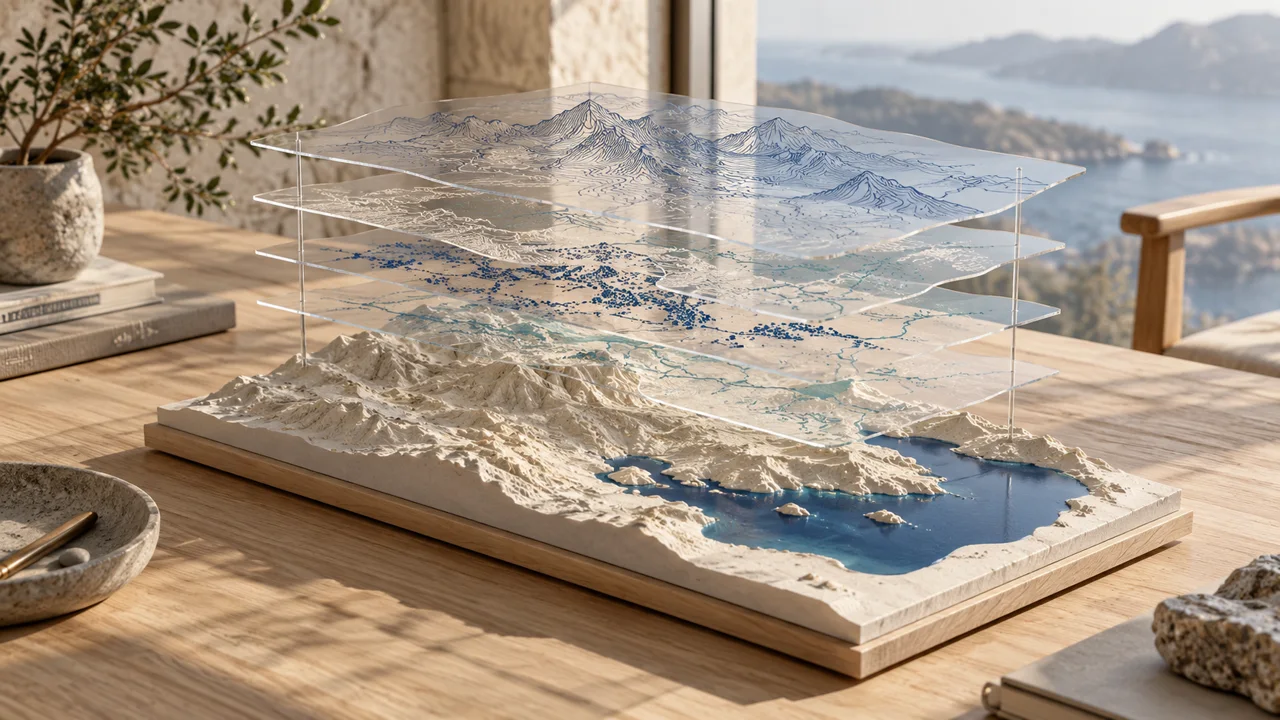

Portal operating diagram
Here, the term denotes an editorial reading of changes over time and in selected directions. The framework’s rules are open and available for discussion.
Time
Heritage, current work or the horizon of a proposal. The time label helps distinguish the original context from a future scenario.
Area of work
We describe a proposed transition: from preserving knowledge to passing it on, from discussion to practice, from an individual case to comparison.
Basis
We preserve the document, observation or argument. The status of a concept, editorial material or proposal is visible on its card.
This is a new descriptive editorial framework, not an implementation of the author’s methods for assessing personality. It has not established predictive accuracy or causal relationships.
Atlas of materials
Combine dimensions to see where topics intersect. An empty result means there is no matching material in the current catalogue.
| Area of work | Heritage | Today | Horizon |
|---|---|---|---|
| Technology | |||
| Territories | |||
| Connections and time |
Select an intersection of topic and time. The other filters remain in place; the number in a cell is the number of materials.
Showing 22 of 22 materials
Public material and proposalsScience, verification of knowledge, cooperation and continuity.
The knowledge relay: a proposed annual cycle of events connecting four platforms. A plan, not an announced museum programme.
Knowledge passes from person to person through a proposed annual cycle of cultural and scientific events.
An artistic film about the future, responsibility, the right to have a voice and revising a shared decision.
Engineering heritage, museum education and contemporary technological culture.
How an object, an explanation and work with a source help pass on engineering experience.
The path from an idea to verification: the task, constraints, testing and result criteria.
People, knowledge, work and cultural memory of rural areas.
Passing on skills, local experience and people’s participation in developing their own place.
Pass on experience together with the conditions, resources and limitations of its use.
How to turn a discussion into a documented relay of tasks and knowledge.
How to read material through theme, time, scale, format and status.
The first electronic issue combines six articles from three portals.
A proposed agenda on knowledge, employment, cooperation and passing on experience.
A proposal for three thematic sections with a shared final resource.
The author’s model of seven phases: from impulse to restart.
Relay cycles as the transfer of information, resources and states between participants.
Entities, connections, protocols, a map, filters and a timeline in an interface design.
The author’s periodisation and scenario-based views of the next stages.
Preserving and describing craft knowledge, people who hold skills and local practices.
The author’s proposals for research, education and technological development.
An announcement of a new collection and related sections released on 3 October 2026.
No materials match yet. Change your query or clear the filters.
The diagram shows the number of entries in this editorial selection after filtering. It represents the contents of the catalogue; no assessment of sectoral or territorial development is calculated here.
Ages and Contexts
The author’s “Map of Civilisational Evolution” describes natural, agrarian, industrial and informational models; subsequent stages are presented as a scenario-based perspective.
Place and skills
Land, craft, season, community and passing on experience. A question to guide reading: how is knowledge retained locally?
Scale and production
Machines, an engineering school and the organisation of production. The question: how can we connect an idea, implementation and verification?
Connections and access
Networks, data and the speed of exchange. The question: how can we preserve the source and responsibility for its interpretation?
Development scenarios
The author’s ideas about subsequent stages. The question: what is proposed for testing, and what further evidence is needed?
These perspectives help compare materials and may coexist within one territory. They do not establish a single scale for ranking how “developed” people and societies are. Open the author’s periodisation ↗
The author’s model of cycles
“Cycle Theory” proposes a sequence of states from impulse to restart. It is presented as the author’s conceptual model; the phase of a particular project must be justified by observations.